Kerala Tour Package
from Ahmedabad
A night on an Alleppey houseboat, Munnar's tea hills, Periyar's lake, Fort Kochi's layered port — God's Own Country, paced not to rush.
A night on an Alleppey houseboat, Munnar's tea hills, Periyar's lake, Fort Kochi's layered port — God's Own Country, paced not to rush.
Kerala is India's most diverse travel destination compressed into one state. In a week you can move from the emerald backwaters of Alleppey to the misty tea estates of Munnar, from the tropical wildlife of Periyar to the Portuguese-and-Dutch heritage of Fort Kochi, to the Ayurvedic cliff-top calm of Kovalam — all within a few hours of one another. It's also India's most literate, safest and most socially progressive state, and that quality of life shows in every part of travelling here. We build Kerala around your pace, not a template — and the one thing we refuse to do is rush it, because rushing is the single most common Kerala traveller's regret.
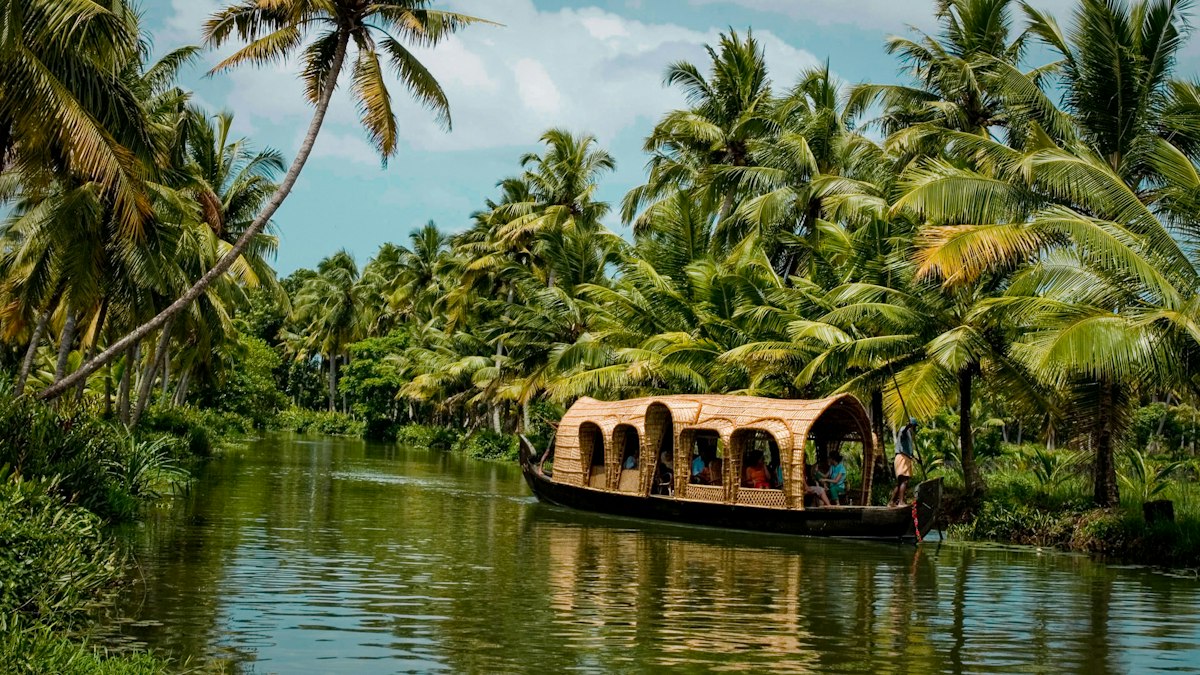
The centrepiece is the houseboat, and it deserves to be. A traditional kettuvallam — teak-built, coir-thatched — becomes your floating home for a night on the Vembanad backwaters, drifting past paddy-field banks and Chinese fishing nets and toddy tappers, with freshly cooked Kerala meals served on board and absolute stillness after dark. It's the most peaceful night available anywhere in India, and not all houseboats are equal — we work only with vetted operators who keep clean vessels, cook well, and crew responsibly. Around it, a typical seven-night route gives two full nights in the Munnar hills and generous time at each stop rather than a checklist scramble: Kochi, Munnar, Thekkady, the Alleppey houseboat, and Kovalam.
Each stop has its own character. Fort Kochi is a layered colonial port you can walk in an afternoon — the cantilevered Chinese fishing nets on the sea wall, the sixteenth-century Paradesi Synagogue, the spice-warehouse lanes of Mattancherry, churches from four European powers. Munnar, at 1,800 metres in the Cardamom Hills, is wrapped in some of India's finest tea estates, with the Eravikulam National Park protecting the endangered Nilgiri Tahr beneath Anamudi, South India's highest peak at 2,695 metres. Thekkady is spice country — a Periyar Lake boat safari scanning the forest edge for elephants and gaur, and plantation walks through cardamom, pepper and clove. And Kovalam closes the trip on the Arabian Sea, with cliff-top beaches and the Ayurvedic spa culture Kerala is famous for.
Two practical truths. First, the season offers two very different trips. October to March is peak — cool, dry, 20–30°C, the hills and houseboats at their most pleasant, December and January the busiest. But the monsoon, June to September, is Kerala's secret: the heaviest rains in India turn the landscape extraordinarily lush, prices drop thirty to forty percent, and it's considered the *ideal* season for genuine Ayurvedic rejuvenation, because the humidity aids therapeutic absorption. April and May bring pre-monsoon heat but also Thrissur Pooram, one of India's most spectacular temple festivals. Second, the things that quietly make or break the trip are handled: the Periyar boat-safari seats are limited and sell out, so we pre-book them, and we pace the driving so the hours between Munnar, Thekkady, Alleppey and Kovalam never swallow the days.
There's a cultural Kerala worth making room for, too. The spice trade that drew the Chinese, Arabs, Portuguese, Dutch and British to this coast is still alive in the Thekkady plantations and the Mattancherry warehouses — Kerala has been the world's pepper and cardamom shelf for two thousand years. The performing arts are extraordinary and unlike anything else in India: Kathakali, the all-night masked dance-drama, and Kalaripayattu, one of the world's oldest martial arts, both of which we can arrange an evening around. The capital, Trivandrum, holds the gold-rich Padmanabhaswamy Temple and the colonial Napier Museum. And if your dates fall in April or May, Thrissur Pooram is one of the country's most spectacular temple festivals. None of it is mandatory — but it's the difference between seeing Kerala and understanding it.
The reason we give Kerala two full nights in Munnar and generous time at every stop is that the most common regret here is a rushed trip — five destinations crammed into five days, half of it spent in the car on the ghat roads. We'd rather do four places properly than six in a blur. The drives between Kochi, Munnar, Thekkady, Alleppey and Kovalam are genuinely scenic but genuinely long, so we schedule them around the best light and the best stops — the Cheeyappara waterfalls on the climb to Munnar, a roadside tea estate, a spice stall — and make the journey part of the holiday rather than the toll you pay for it.
For honeymooners, Kerala is consistently ranked among India's most romantic destinations — and it earns it. The houseboat night with personalised service, an Ayurvedic couples' treatment in a Kovalam cliff-top spa, a private sunset cruise on the backwaters, the sheer overwhelming green of it all. We arrange the floral room, the candlelit table-for-two, the private boat — and otherwise let God's Own Country do what it does.
A teak-and-coir kettuvallam as your floating home on the Vembanad backwaters — paddy-field banks and Chinese fishing nets and toddy tappers sliding past, fresh Kerala meals cooked on board, kingfishers at dawn and total stillness after dark. The most peaceful night available anywhere in India, on a vessel we've personally vetted for kitchen, cleanliness and crew.
The Cardamom Hills at 1,800 metres wrapped in emerald tea estates — Mattupetty Dam, Echo Point, the Tea Museum and factory — and the Eravikulam National Park with its endangered Nilgiri Tahr grazing beneath Anamudi, South India's highest peak at 2,695 metres. Cool mountain air and the impossible green that gives Kerala its name.
A boat safari across Periyar Lake at Thekkady, scanning the forested shore for elephants and gaur, and a walk through plantations of cardamom, pepper and clove — the aromatic heart of India's spice trade, seat pre-booked so the day is yours.
The cantilevered Chinese fishing nets at sunset, the sixteenth-century Paradesi Synagogue, the spice lanes of Mattancherry, churches built by four European powers — five hundred years of trading history within an afternoon's walk.
The cliff-top beaches of the Arabian Sea — Lighthouse, Hawah, Samudra — and the Ayurvedic spa culture Kerala built its wellness reputation on. The trip's restful close, and the home of its couples' treatments.
The houseboat night with a floral turn-down, an Ayurvedic couples' treatment on a Kovalam cliff, a private sunset cruise on the backwaters, a candlelit table for two. The romance set up before you arrive, the green doing the rest.
Download a sample itinerary for Kerala — pacing, day-by-day notes, what's included, and how we'd reshape it around your dates and your style.