Vietnam Tour Package
from Ahmedabad
An overnight junk on Ha Long Bay, Hoi An by lantern-light, the Golden Bridge above the clouds — the country the standard South-East Asia circuit saves for last.
An overnight junk on Ha Long Bay, Hoi An by lantern-light, the Golden Bridge above the clouds — the country the standard South-East Asia circuit saves for last.
Vietnam is the trip we recommend to travellers who've already done Thailand, Singapore and Bali and want the next level — deeper, more historically layered, more visually dramatic. It's a country shaped by centuries of Chinese, French and American influence, and the result reveals itself slowly and generously: the haunting limestone karsts of Ha Long Bay, the lantern-lit streets of Hoi An's ancient town, the chaos and colour of Hanoi's old quarter, and the Golden Bridge floating above the clouds at Bana Hills. And the food — built on balance and fresh herbs — is one of the world's great underrated cuisines, which for an Indian traveller is a happy surprise once you know where to point: a bowl of pho at a roadside stall in Hanoi, a tailor's silk dress run up overnight in Hoi An, a junk anchored in the bay as the mist lifts — the small, specific moments are what people carry home from Vietnam, more than any single monument.
Our core Vietnam tour runs the north-and-centre spine — Hanoi, Ha Long Bay, Da Nang, Hoi An and Bana Hills — over six or seven nights, with the internal flight from Hanoi to Da Nang built in so you cover the distance without losing a day to it. It opens in Hanoi with the old quarter's thirty-six craft streets, Hoan Kiem Lake, the Ho Chi Minh complex and a water-puppet show; threads out to Ha Long for the centrepiece night afloat; flies to Da Nang for the coast and the Lady Buddha; and gives its best central days to a coconut-village basket-boat, Hoi An's ancient town, and the Golden Bridge.
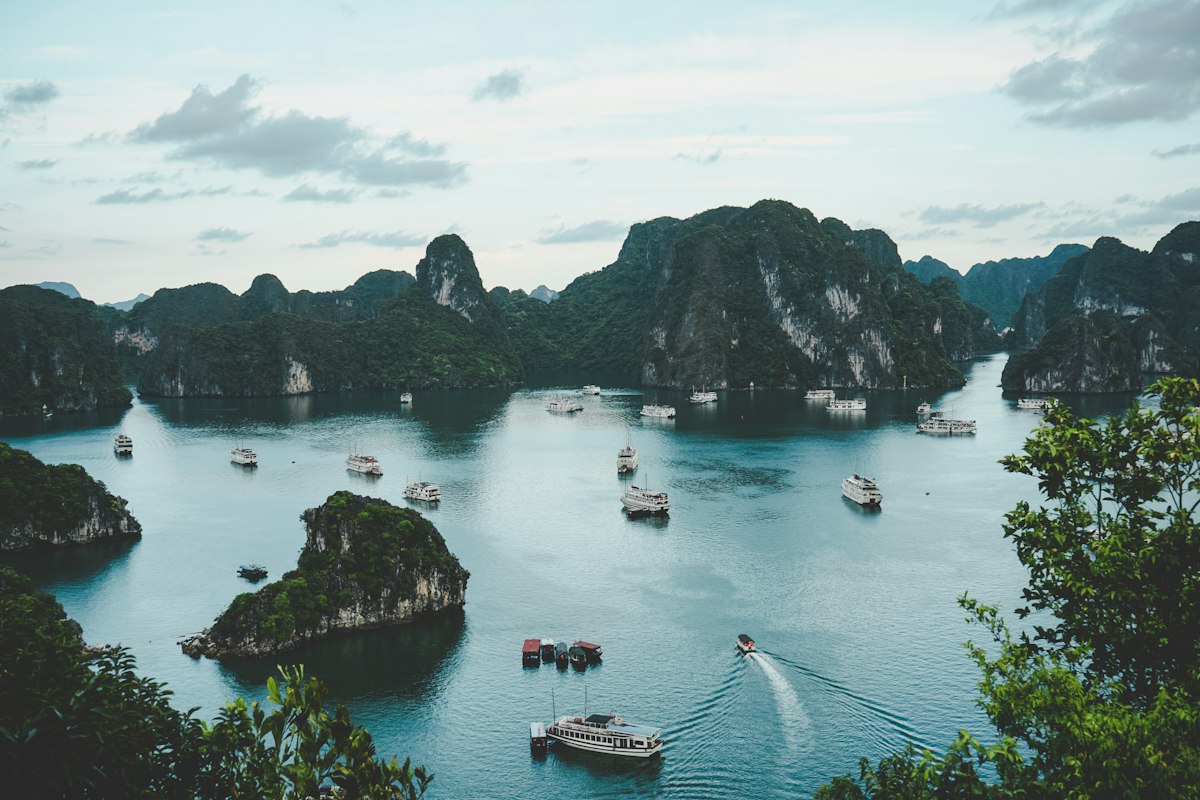
The Ha Long overnight is the heart of it, and it's the one place we hold a hard line. Our package always includes the overnight cruise on a junk boat — watching the karsts emerge from the morning mist from the top deck at first light is one of travel's genuinely transcendent experiences, and a day trip simply doesn't give you that. We never substitute the day trip to save a few rupees. We'll be transparent about format, though: the cruise is sold as a shared luxury junk without a private guide on that leg — standard, and well run — and for honeymooners or families who want a private cabin experience or a smaller boat, we arrange the upgrade and tell you what it costs.
Two practical truths. First, the season splits the country: October to April is ideal for our Hanoi–Ha Long–Da Nang route, with the north cool and dry at 15–22°C in winter, while the central coast around Da Nang and Hoi An is best February to August and takes its heaviest rain in October–November, which we plan around rather than into. Second, the visa is simple — an e-Visa, valid up to 90 days, applied online — and we handle the whole application for every client, so it never becomes your admin. On food, Vietnamese cooking is lighter and more vegetable-forward than most of the region, and we map the reliable vegetarian and Indian options across each city so the eating is a pleasure rather than a negotiation.
For honeymooners and couples, Vietnam has a quieter romance than the beach destinations — a private balcony cabin on the Ha Long junk, the lantern-lit lanes of Hoi An after the day-trippers leave, a tailor in Hoi An running up a silk dress overnight, dinner by the river. It rewards travellers who like their romance with a little texture and history rather than only a pool and a view, and we shape the trip toward stillness where you want it. For families, the same trip reads differently — the basket boats and the cable car and the puppet show carry younger travellers easily — which is part of why Vietnam works across the small groups we plan for.
A night aboard a junk among the limestone karsts — kayaking and a cave or a quiet beach in the afternoon, dinner on deck, and the islands emerging from the mist at first light. The package always includes the overnight; we never swap it for a day trip, and we'll arrange a private cabin or a smaller boat if you want the bay closer to yourselves.
The UNESCO-listed ancient town of yellow merchant houses and the Japanese Covered Bridge, the streets of silk lanterns lit after dark, the river dotted with paper-lantern boats, and a tailor who can run up a made-to-measure piece in 24–48 hours. The most atmospheric evening in Vietnam, walked after the day crowds have gone home.
The 150-metre walkway held aloft by two giant stone hands, 1,400 metres up and seemingly floating in cloud, reached by one of the world's longest single-wire cable cars. Vietnam's most photographed sight — and the French Village and Fantasy Park to fill out the day.
The thirty-six craft streets each once devoted to a single trade, Hoan Kiem Lake at dawn, the Ho Chi Minh complex and One Pillar Pagoda, a traditional water-puppet show, and the Train Street where the railway threads between the houses (viewing subject to current rules). The chaotic, layered, deeply photogenic heart of the north.
The coconut-water village outside Hoi An — the round bamboo basket boats, crab-fishing in the palms, the local cultural performances. A genuinely local, unhurried morning of the kind the brand is built around, not a stage-managed photo stop.
The coast at Linh Ung Pagoda beneath the towering Lady Buddha statue, the views out over the Son Tra Peninsula, and the markets of the city itself — the relaxed seaside counterpoint between the bay and the mountains.
Download a sample itinerary for Vietnam — pacing, day-by-day notes, what's included, and how we'd reshape it around your dates and your style.